
Follow the Leader
What Rakim, Blackstone, and a $2.28 billion overnight block trade in Digital Realty have in common. And what “6.5% stabilized” is telling you if you know how to listen.


Press play. This one wants a soundtrack.
A note for the fans. “Follow the Leader” is the opening track of Eric B. & Rakim’s second album, released July 1988. Their first album, released the summer before, was called Paid in Full. Two consecutive album titles that happen to describe exactly what Blackstone did between 5 p.m. Monday and 10 a.m. Tuesday: got paid in full, and demonstrated why the leader is the one to follow. Two record titles, one trade. Rakim’s 1987–88 discography turns out to be the structural spine of this piece, which we did not notice until we sat down to write it.
“Follow the leader / Follow the leader.”
Rakim recorded that hook in Manhattan in the spring of 1988 with the confidence of a man who understood that the whole point of being the leader was that you didn’t have to explain what you were leading anyone toward. The people who followed would find out where they were going after they got there. This is also, structurally, the entire Blackstone real estate franchise, and it is why the trade Blackstone announced last week deserves more than the “strategic partnership” gloss the Digital Realty comms team has been shopping.
The Deal, One Line
Blackstone owned 80% of two 96-megawatt data centers at the Digital Carver Brickyard campus in Manassas and 50% of one 96-megawatt center at Digital Carver Dulles 9 in Sterling. Blended equity: 64%. Portfolio: 288 megawatts of IT capacity across three buildings, fully leased on 15-year contracts to a blended AA- customer with 3.6% annual escalators. On Monday, June 29, 2026, Blackstone sold that stake to Digital Realty for a headline $3.5 billion: $1.2 billion in cash and $2.3 billion in DLR common stock. The transaction closed on Tuesday, June 30. Gross portfolio value at 100% share, including assumed debt and remaining development capex to complete: $7.8 billion. Expected initial stabilized cap rate on the vintage: just over 6.5%.
Hold the 6.5% in one hand. Hold the overnight in the other.
The Overnight
On Tuesday morning, less than twenty-four hours after Blackstone was paid in $2.3 billion of Digital Realty common stock, Digital Realty priced a secondary offering of the exact 12,310,249 shares Blackstone had received the previous day. Underwriter: Morgan Stanley. Solo. Price: $185.00 per share. DLR’s Monday close: $190.58. Its pre-announcement close on Friday: $184.90. Net-of-fees proceeds to Blackstone: somewhere in the neighborhood of $2.25 billion of hard, cold, thank-you-for-your-service cash. Time elapsed from “we are being paid in Digital Realty stock” to “we are not being paid in Digital Realty stock anymore”: approximately the length of one Yankees–Red Sox game.
Blackstone did not take DLR shares because they wanted DLR exposure. They took DLR shares because that is how Digital Realty’s balance sheet let them get the deal done at $7.8 billion. Then they turned the shares into cash the following morning, at a print $5.58 below Monday’s close and flat to the pre-deal spot, because holding public REIT paper past a filing window is a set of risks (mark-to-market, sector correlation, lockup optics, one PagerDuty alert on any competitor) that a large private-equity manager evaluates on a spreadsheet with maybe ninety seconds of debate. The vote is always the same. Turn the stock into cash. Turn it into cash now. Turn it into cash before the receptionist figures out what happened.
Follow the leader.
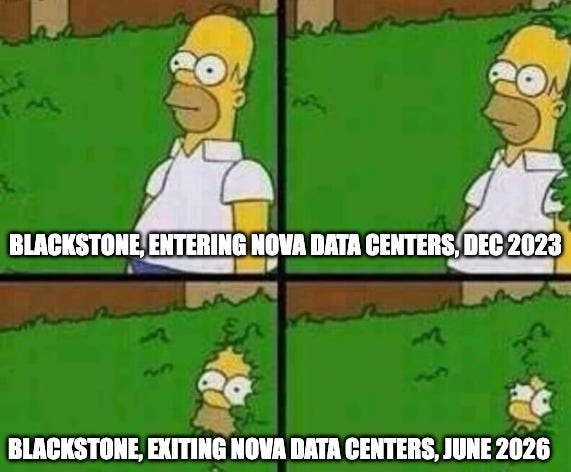
About That 6.5%
Digital Realty’s press release led with an “expected initial stabilized capitalization rate of over 6.5%.” Every wire story that ran Monday afternoon copy-pasted the phrase. Every sell-side note on Tuesday morning anchored on the phrase. We would like, gently, to point at the phrase.
“Expected.” It’s a target, not a fact. Two of the three buildings stabilize in the first half of 2027. The third stabilizes in the first half of 2028. The 6.5% assumes the leases ramp on schedule, the tenants draw the power they’ve committed to, and nobody renegotiates anything in the intervening eighteen to twenty-four months. Any one of those slips, the number slips with it.
“Initial.” As in, the first year of stabilized NOI. Not year two. Not the levered IRR on the equity. Not the yield on cost after year-one lease rollovers or true-ups.
“Over 6.5%.” Over what by how much? The IR team is not saying. It could be 6.51%. It could be 7. In our experience, when a REIT rounds a number up rather than disclosing it, the disclosure is doing less work than the rounding.
And it’s a future number against a future basis. The $7.8 billion “gross value at 100% share” includes remaining capex to complete the development. The 6.5% is (projected 2027-2028 stabilized NOI) divided by (today’s basis plus tomorrow’s construction spend). That is a legitimate way to quote a stabilized cap on a development deal. It is also, structurally, a return on total investment computed at the end of the project. It is not a going-in yield anyone is currently earning. On what the assets are producing today, against today’s basis, the number is materially lower than 6.5%. Somewhere in the mid-4s would be our guess. That is the same 4-handle Signal Line said in May was too tight for the risk.
None of this makes the deal bad for Digital Realty. Buying a well-leased 288-MW NoVa platform at a stabilized underwrite that clears their cost of equity is a fine trade for DLR shareholders, if the leases ramp as advertised. What it is is a print with two Rorschach tests inside it. The bull sees 6.5% stabilized and hears a cycle bottom called in daylight. The bear sees 6.5% stabilized and asks what “over” is doing, what “expected” is doing, and what the going-in yield actually is against today’s NOI. Both answers are legitimate. Neither answer is a level that would have let Blackstone hold for another two years without repricing the JV in their own book.
The mechanism is the tell either way. Blackstone accepted the print, took the cash, and cleared the paper inside a twenty-four-hour window. The number on the press release is a target. The number that landed in Blackstone’s wire on Wednesday morning is a settled fact.
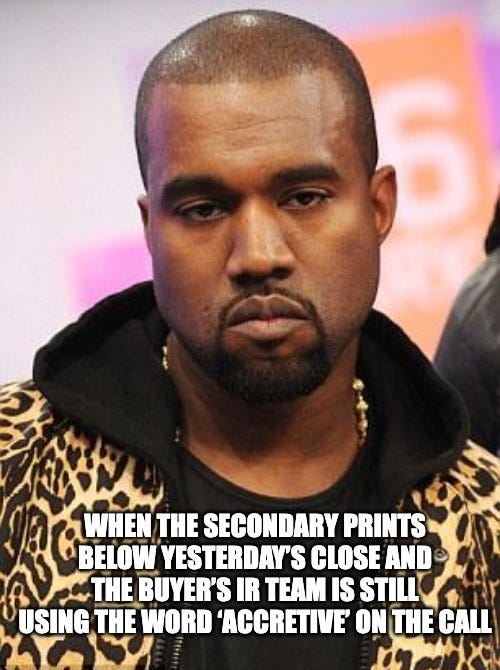
The Pattern
Blackstone is not always the top-caller. In our defense of institutional memory, they bought Hilton for $26 billion in July 2007 and rode it into the crisis, and they bought EQ Office from Sam Zell for $39 billion the same year and ate a piece of that trade. Bad-timing examples exist. What is more useful is the list of times Blackstone has been the seller into consensus, because that list is short, and it clusters near the top of cycles.
Trizec Properties, October 2006. Blackstone sold $8.9 billion of large-cap Canadian and U.S. office to Brookfield five months before Zell exited EOP and about fifteen months before the office cycle went sideways for a decade. Brookfield eventually made money. Not on the entry vintage.
Equity Office flip, February through April 2007. Blackstone bought EOP from Zell for $39 billion on February 9, 2007 and, over the next ten weeks, flipped roughly $28 billion of the portfolio to Macklowe, Tishman Speyer, Beacon Capital, and Shorenstein. The flip-buyers got vaporized. Macklowe lost the GM Building in the workout. There is a version of the story in which Sam Zell called the top, Blackstone extended the top-call by ninety days by handing off the parts of the portfolio that were still trading, and the flip-buyers underwrote 2015 rents in early 2007. That version is the correct one. We know because we have met some of the flip-buyers.
Invitation Homes, January 2017 through November 2019. Blackstone assembled 50,000 SFR doors for a blended basis around $175,000 a door, IPO’d in January 2017 at $20, and sold down through follow-ons until they were fully out by November 2019 at around $27. The exit window happened to overlap with the twelve months during which every institutional allocator in America decided that scattered-site rental was a real asset class. Very coincidental.
BREIT redemption gate, November 2022. Not a portfolio sale, but on the same shelf. Blackstone hit the semi-annual gate on their $69 billion non-listed REIT, then held it gated through most of 2023. This was the earliest signal any large real-estate manager gave that private CRE marks were about to reprice: public office was down 40% at the time; private office was down 8%. Twelve months later, private caught up.
The pattern is not that Blackstone is infallible. It is that when Blackstone is selling the marginal unit of a sector into a bidding market, and doing it in cash, the LP holding the paper on the other side of the trade should raise an eyebrow. Or at least, ask why the flow is available.
Why We Care
We put data centers on the Scoreboard as a SHORT in Issue 1 on May 15 and reloaded the call in Issue 2 on June 15 by naming what we didn’t lean on the first time: terminal value. We were on the short side of this early. Not first, not alone, not the loudest. But early enough that the call was on the record. Whether last week is the sector’s foretelling or a one-off, we don’t know yet. We know which way we’d bet.
The Take
The entry vintage on hyperscale NoVa is closed. That is not the same as saying the sector is done. It is saying that from here, returns come from operator alpha, tenant credit, and length-of-lease. Not from developing a site at a 30% margin and marking to a 4.5 cap. If your data-center underwrite still assumes it will come from the development margin, congratulations, you are Harry Macklowe in April 2007. The building is still fine. The equity is not.
Transmission is arriving. FERC Order 1920 starts ratepaying its way into new interstate build by 2028. Georgia Power just filed a 3.4 GW procurement for 2029 delivery. ERCOT cleared 44 GW of committed interconnection load in H1 2026. Somewhere, in one of these markets, transmission catches up to demand first. When it does, the 4-handle vintage does not come back. The 6.5%+ Digital Realty just paid becomes the new floor, not the new ceiling.
Blackstone told you which vintage of the trade is done. They told you in a press release. Then they told you again in a secondary offering at 5:00 p.m. on a Tuesday, because they wanted to make sure you were paying attention.
Signal Line’s call, unchanged from Issue 2. SHORT the AI-infrastructure buildout at sub-5 caps on GPU-heavy campuses. LONG the towers. LONG the operators of legacy interconnect where the fiber is already in the ground. We were early in May. Blackstone is telling you we were early on purpose.
Sources
Digital Realty Trust, “Digital Realty Announces Purchase of Blackstone Interest in Three Northern Virginia Data Centers,” June 29, 2026 — press release; Blackstone, corresponding press release; Digital Realty Form 8-K and Exhibit 99.1 (June 29, 2026); Digital Realty, “Digital Realty Prices Secondary Offering of Common Stock by Blackstone,” June 30, 2026 — investor release; Stocktitan reporting on the 12,310,249-share block at $185.00; Quiver Quantitative on Tuesday’s price action; DatacenterDynamics coverage of Digital Carver Brickyard and Dulles 9; Commercial Observer; The Real Deal; Stifel research maintaining DLR at $235 PT on the deal.
Historical portfolio-sale references: Blackstone / Brookfield Trizec Properties take-private, October 2006; Blackstone Equity Office Properties acquisition and subsequent asset flips to Macklowe, Tishman Speyer, Beacon Capital, and Shorenstein, February–April 2007; Blackstone Invitation Homes IPO S-1 (January 2017) and subsequent Form 4 filings through 2019 documenting the wind-down; Blackstone Real Estate Income Trust (BREIT) redemption gate first triggered November 30, 2022, per subsequent quarterly disclosures. Bloomberg, “Blackstone Exits Hilton, Earning $14 Billion After 11 Years,” May 18, 2018 — for the Hilton bad-timing counterexample.
Signal Line’s prior data-center calls: The Signal from the Noise, Issue 1 (May 15, 2026) and Issue 2 (June 15, 2026), Substack.
Music: Eric B. & Rakim, “Follow the Leader,” from Follow the Leader, Uni Records / MCA, released July 25, 1988 — Spotify.
Nothing here is investment advice. It’s what we actually think, which we realize is rarer than it should be.
Signal Line has no active position in Digital Realty (DLR), Blackstone (BX), or the underlying joint venture. We have been short the AI-infrastructure real-asset trade in commentary since May 2026 and have no plans to change that call as a result of this transaction. Meme selection went to a partner vote; Homer hedges and Kanye “Follow God” both cleared unanimously. Tom, taking the epigraph seriously, has ordered a black Kangol 504 flat cap through the firm’s Amazon Business account and is presently wearing it on the boardwalk in Point Pleasant. He has been informed that (1) Rakim wore the bucket, not the 504, and (2) the New Jersey lot-rent cap has still not been interviewed. Tom has responded that these are two different caps and he is only responsible for one of them. The methodology is holding up.
Somewhere, Harry Macklowe read this, nodded, and quietly closed a data-center pitch deck.
On Tuesday morning, June 30th, less than twenty-four hours after Blackstone was paid in $2.3 billion of Digital Realty common stock, Digital Realty priced a secondary offering of the exact 12,310,249 shares Blackstone had received the previous day. Underwriter: Morgan Stanley. Solo. Price: $185.00 per share. DLR’s Monday close: $190.58. Its pre-announcement close on Friday: $184.90. Net-of-fees proceeds to Blackstone: somewhere in the neighborhood of $2.25 billion of hard, cold, thank-you-for-your-service cash. Time elapsed from “we are being paid in Digital Realty stock” to “we are not being paid in Digital Realty stock anymore”: approximately the length of one Yankees–Red Sox game.